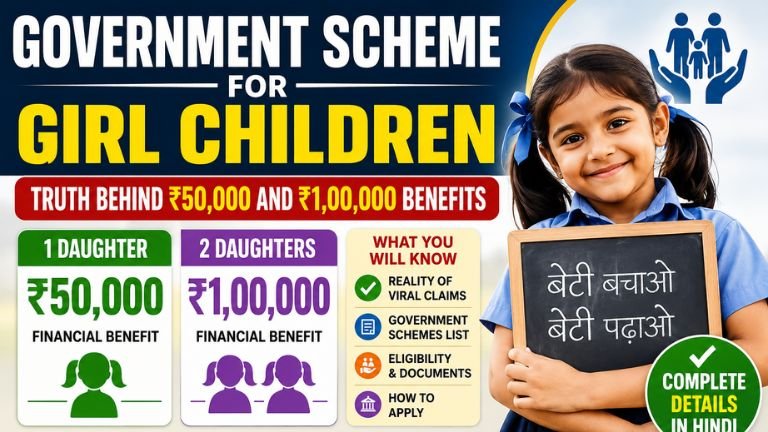
Government Scheme for Girl Children : Truth Behind ₹50,000 and ₹1,00,000 Benefits
In recent times, social media platforms have been flooded with messages claiming that the government is offering ₹50,000 for families with one daughter and ₹1,00,000 for those with two daughters. These claims have quickly gained attention, especially among parents looking for financial support for their children. However, the big question remains — is this information completely accurate?
To avoid confusion, it is important to understand the reality behind these viral claims and explore the actual government schemes available for the welfare of girl children in India.
Is the ₹50,000 or ₹1,00,000 Scheme Real?
Let’s clarify this first. There is no single nationwide government scheme that directly provides a fixed amount of ₹50,000 or ₹1,00,000 simply based on the number of daughters in a family.
The confusion mainly arises because multiple central and state government schemes offer financial assistance at different stages of a girl child’s life. When these benefits are combined over time, the total amount may reach or even exceed ₹50,000 or ₹1,00,000. This is why such messages often go viral and are misunderstood as a direct cash benefit.
Central Government Schemes for Girl Children
The Government of India has introduced several initiatives to support the education, health, and financial security of girl children. These schemes focus on long-term development rather than providing instant cash rewards.
Sukanya Samriddhi Yojana (SSY)
One of the most popular and trusted schemes is Sukanya Samriddhi Yojana.
Under this scheme:
- Parents can open a savings account in the name of their daughter
- Deposits can be made regularly with flexible amounts
- The government provides a high interest rate compared to many other savings options
- The maturity amount can be used for higher education or marriage
This scheme does not offer immediate cash benefits, but it helps families build a strong financial fund for their daughter’s future.
Beti Bachao Beti Padhao
Another major initiative is Beti Bachao Beti Padhao.
This program focuses on:
- Promoting the value of girl children
- Improving access to education
- Reducing gender discrimination
Although it does not provide direct financial assistance, it plays a crucial role in encouraging families to invest in their daughters’ education and well-being.
State Government Schemes for Girl Children
Apart from central schemes, many state governments offer financial assistance programs that directly or indirectly benefit families with daughters.
Andhra Pradesh – Girl Child Protection Scheme
In states like Andhra Pradesh, schemes such as Girl Child Protection Scheme provide financial support.
Key features include:
- Financial deposits made in the name of the girl child
- Benefits for families with one or two daughters
- Funds released when the girl reaches adulthood
- Special focus on economically weaker sections
This scheme encourages families to invest in the education and future of their daughters while discouraging child marriage.
Other State-Level Schemes
Several other states also run similar welfare programs:
- Telangana offers financial assistance and incentives for education
- Tamil Nadu provides schemes supporting girl child welfare and marriage assistance
- Various states provide scholarships, birth incentives, and educational benefits
When these benefits are combined over time, the total financial support may reach ₹50,000 or even ₹1,00,000, depending on eligibility and participation.
Why Do These Claims Go Viral?
The main reason behind such viral messages is misunderstanding. People often combine benefits from multiple schemes and assume it is a single government program.
Additionally:
- Social media forwards are often incomplete or misleading
- Lack of awareness leads to confusion
- People tend to believe financial benefits quickly without verification
This is why it is always important to verify information before trusting or sharing it.
Eligibility Criteria for Girl Child Schemes
Most government schemes come with certain conditions that families must meet. These may include:
- Income limits (for economically weaker sections)
- Proof of identity such as Aadhaar card
- Birth certificate of the girl child
- Bank account details
- Regular school attendance
- Compliance with family planning norms (in some schemes)
Meeting these requirements is essential to receive benefits under any scheme.
Main Objectives of These Schemes
Government schemes for girl children are designed with long-term goals in mind. Their primary objectives include:
- Promoting gender equality
- Encouraging education among girls
- Reducing child marriage
- Improving financial security for women
- Changing societal attitudes toward daughters
Over the years, these initiatives have played a key role in improving female literacy rates and empowering women across the country.
More Details / Official Information
To explore official government schemes and get accurate details, visit:
How to Check Genuine Information?
Instead of relying on viral messages, parents should always verify details through official sources. You can:
- Visit government websites
- Check announcements from authorized departments
- Visit Village or Ward Secretariats
- Contact local officials for guidance
This ensures that you receive accurate and updated information.
Final Thoughts
The claim that the government directly gives ₹50,000 for one daughter and ₹1,00,000 for two daughters is not entirely true. However, it is also not completely false when viewed in a broader context.
In reality, multiple government schemes — both at the central and state levels — provide financial assistance at different stages of a girl child’s life. When these benefits are combined, the total support may reach similar amounts.
Parents should take advantage of these genuine schemes to secure their daughters’ future. By focusing on education, savings, and long-term planning, families can ensure financial stability and better opportunities for their children.